The Makers
Paul h. Young
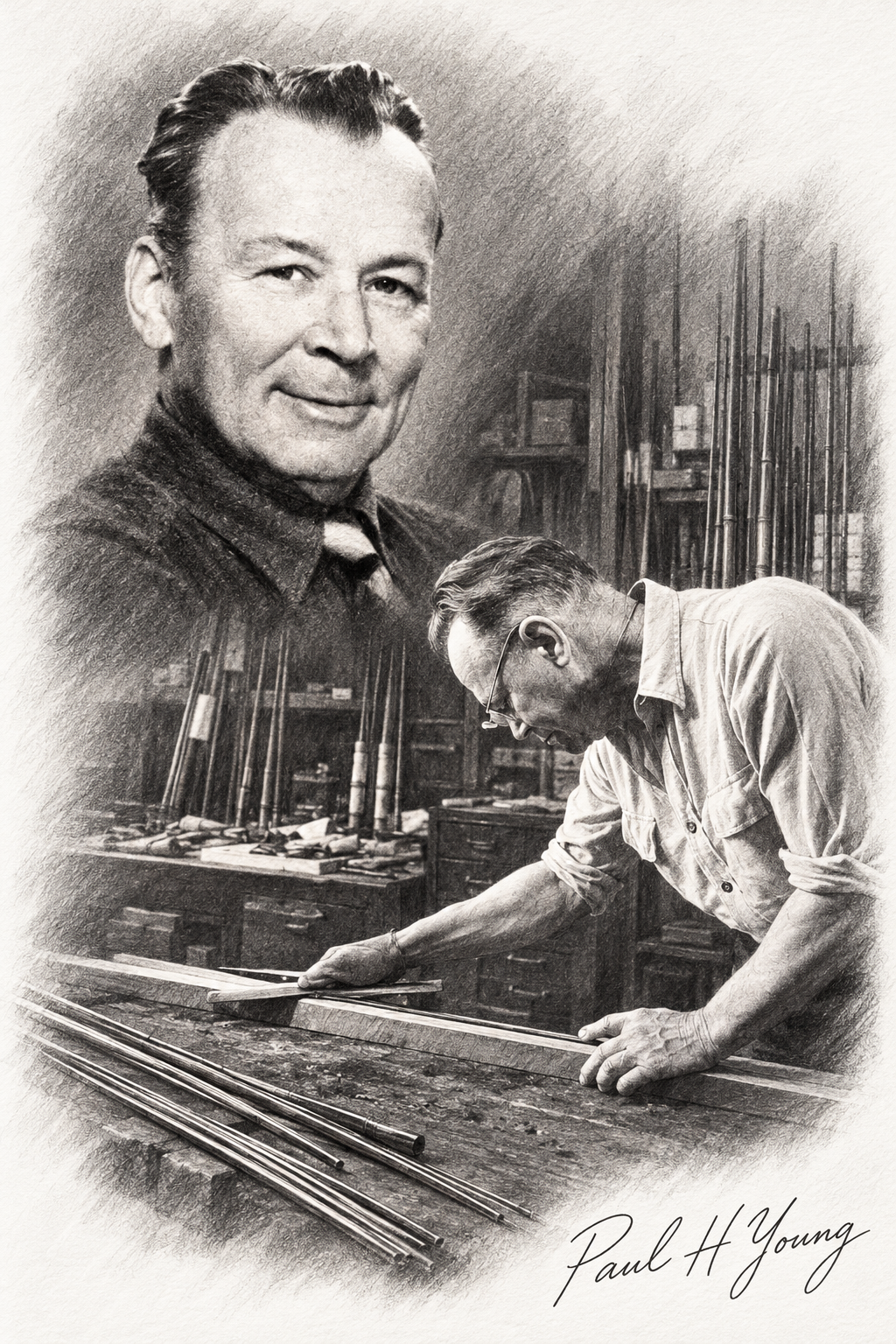
Detroit, Michigan — Tapers shaped by fishing
Paul Holden Young’s reputation rests above all on the character of his rod designs. His finest work brought together lightness, sensitivity and a distinctive distribution of power, producing rods whose influence extended far beyond his Detroit shop.
Born in 1890, Young worked as a taxidermist, fly tier and guide before establishing his Detroit fishing business in 1926. His wife, Martha Marie, was a lifelong companion in both fishing and business, and would lend her name to one of his enduring rod models.
From an early stage, Young challenged prevailing ideas about rod length and weight. His shorter, lighter designs were initially dismissed by some anglers as toys. Their subsequent acceptance reflected an understanding of what a thoughtfully designed small rod could accomplish. His interests also extended to flies, leaders and presentation; rod design formed part of a complete approach to fishing.
The taper came first
Young’s contribution was particularly important in the development of American parabolic rods. Encounters with Charles Ritz and discussions involving makers such as Jim Payne and Everett Garrison helped inform his exploration of these actions. He developed the ideas into a varied family of fishing rods with their own identities.
His tapers were continually refined. Surviving rods document different tips, experimental configurations and variations within the same model. Some were supplied with separate wet-fly and dry-fly tips, allowing the angler to alter the rod’s behaviour while retaining the same butt section. A model name therefore identifies a family of designs rather than guaranteeing one unchanging casting action.
The Parabolic 15, usually an eight-foot rod, became his most celebrated design. In Gerald S. Stein’s survey published in The American Fly Fisher in 1991, no individual model was cited more frequently as a favourite. Bob Summers nevertheless identified at least six versions of the Para 15—an important reminder of the experimentation behind its reputation.
Young’s own lightweight Para 15, built in April 1951, provides a particularly personal glimpse of his confidence in the design. Among the specifications written on its bamboo was the declaration: “Best rod in the world.”
Small rods with distinct purposes
The Perfectionist, at seven feet six inches, and the diminutive Midge, at six feet three inches, express another side of Young’s achievement. Stein regarded both as particularly original designs, demonstrating how much individuality and fishing capability Young could build into a short rod.
The Midge became especially closely associated with Arnold Gingrich. Its capabilities attracted attention when Gingrich used one for Atlantic salmon, although Young himself worried about the little rod being subjected to work for which it had never been intended. The story captures both its surprising ability and its maker’s practical understanding of its limits.
Other familiar names included the Driggs, commonly seven feet two inches, and the Martha Marie, commonly seven feet six inches. Surviving examples show variations in weight, fittings and tip dimensions, preserving evidence of a workshop responsive to individual requirements.
Performance and finish
Young’s rods often carried beautifully mottled, flame-treated cane, simple cork reel seats and restrained furnishings. Their appearance could be highly distinctive, yet the varnishing did not always approach the consistency of the finest cosmetic work of the period. Stein explicitly distinguished the brilliance of Young’s designs from occasional imperfections in their execution.
It is fair to place fishing performance at the centre of Young’s legacy. It would be less accurate to suggest that he was indifferent to finish. In a 1955 letter to Chauncy Lively, discussing a poorly maintained rod returned for repair, Young expressed concern about its appearance and proposed refinishing it. He understood that a rod seen in another angler’s hands also represented his workshop.
The distinction lies in what made his work exceptional. A Young rod’s lasting importance comes from the taper, its response to the caster and its usefulness on the water. The finish accompanies those qualities; it does not fully explain them.
A continuing influence
Bob Summers became an important part of the Young workshop during Paul’s lifetime and continued building its designs after Young’s death in 1960. Surviving records distinguish rods made across these periods, documenting a tradition carried forward through skilled hands.
For Alder Creek, Young’s appeal lies in this close relationship between design and fishing experience. His rods invite attention to how they load, deliver a fly and respond under a fish. Their individuality rewards time on the water—the setting in which his work is most fully understood.
Sources
Catskill Fly Fishing Center and Museum — Paul Young. His early light rods, fishing methods and the Midge.
Gerald S. Stein — “Personal Treasures: The Bamboo Fly Rods and Reels Fishermen Love,” The American Fly Fisher, Fall 1991, pp. 20–21. Assessment of Young’s tapers, varnish work, Para 15 variations and Bob Summers’s contribution.
Robert Jon Golder — Paul H. Young Database. Research documenting surviving rods, markings and workshop history.
Paul H. Young Database — Non-Serial-Numbered Rods. Young’s personal Para 15, experimental rods and correspondence with Chauncy Lively.
Paul H. Young Database — Serial-Numbered Rods. Individual model specifications and production records.
Italian Bamboo Rodmakers Association — Bamboo Journal, No. 17, November 2016, p. 56. Biographical background, Martha Marie and the development of Young’s parabolic designs.