“The Makers”
c.f. orvis and wes jordan
Manchester, Vermont — Charles Orvis’s foundation and the Wes Jordan years
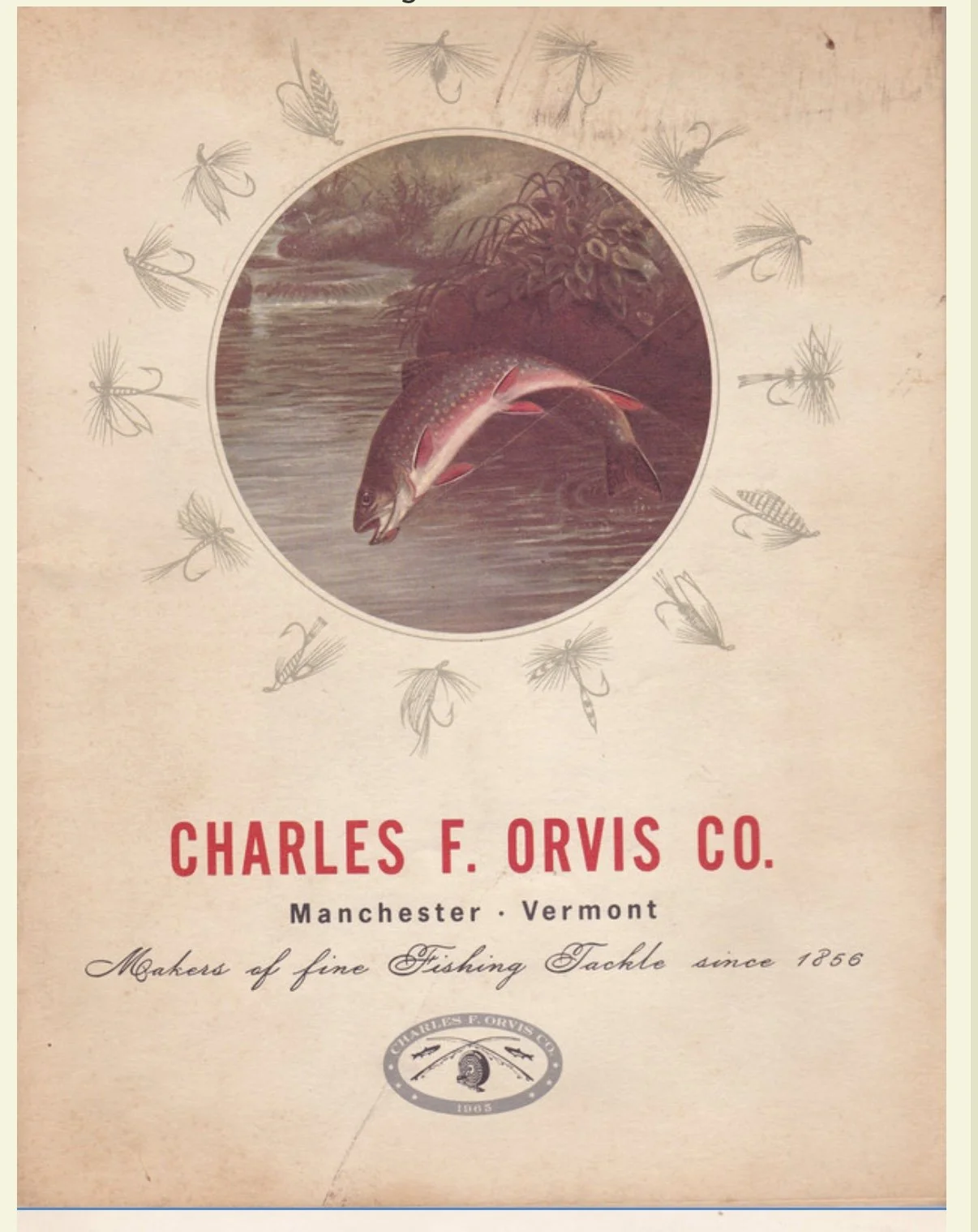
Founded in Manchester, Vermont, in 1856, the C.F. Orvis Company holds an important place in American fly-fishing history. Charles Frederick Orvis combined the abilities of a mechanic with the experience of an angler. His early rods were made from woods including ash and lancewood, with bamboo entering the range by the late 1870s. His patented reel of 1874, with its perforated construction and narrow spool, became a landmark in American tackle design.
The business developed beyond rods and reels. Charles’s daughter, Mary Orvis Marbury, directed the company’s fly-tying operation and helped establish its reputation for artificial flies. Together, their work made the Manchester company a recognised source of tackle and angling knowledge, reaching customers far beyond Vermont through its catalogues.
Yet one of the most influential chapters in Orvis rodmaking began decades later, when Wes Jordan brought his considerable experience to the Manchester workshop.
Wes Jordan and the revival of the rod shop
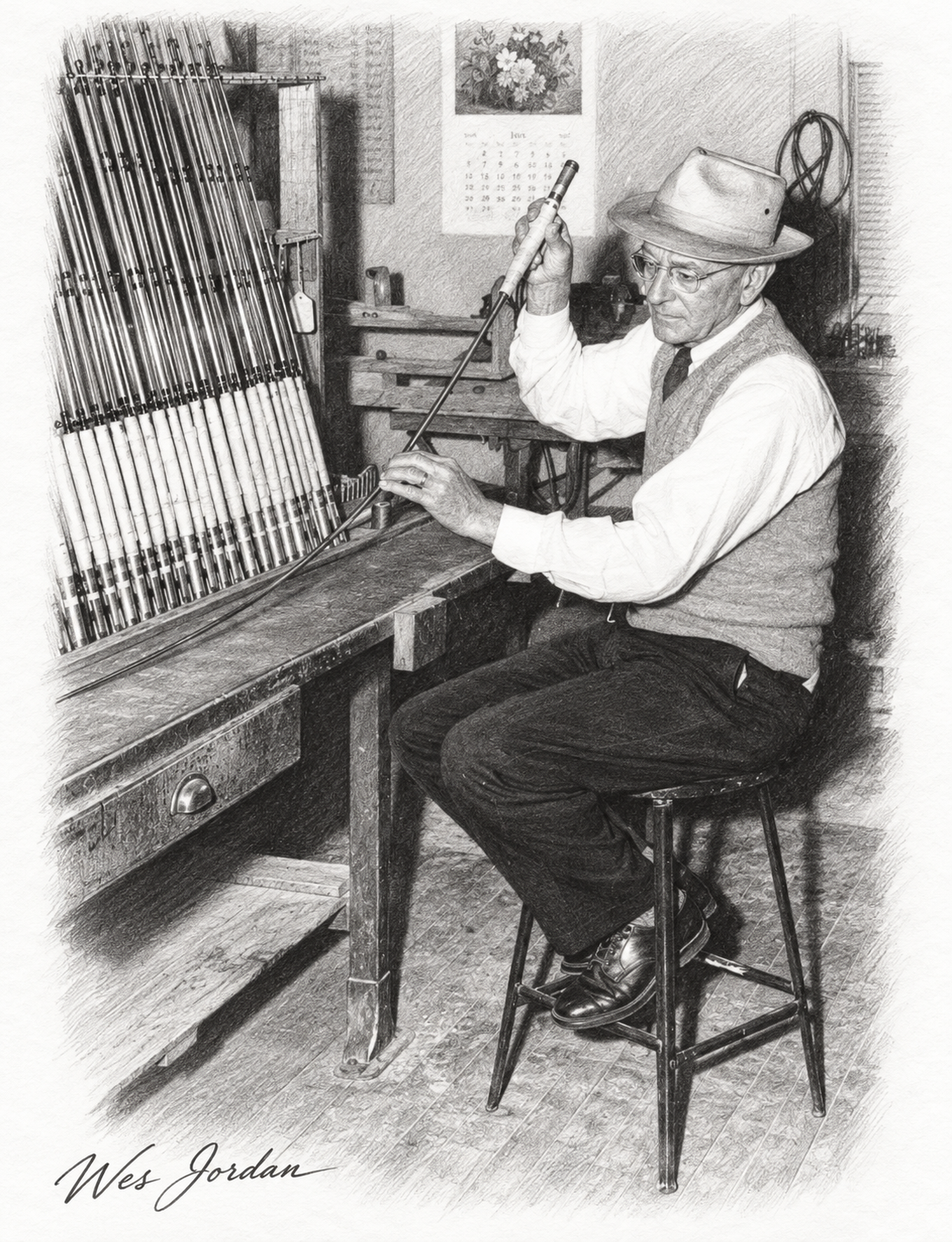
When D.C. “Duckie” Corkran purchased Orvis in 1939, the company entered a period of renewal. Central to that revival was Wesley D. Jordan, an experienced rodmaker whose career had taken him through Cross and South Bend. He brought both an understanding of fine bamboo rods and the mechanical ability to improve the equipment used to build them.
Around 1940, Jordan took charge of Orvis rod production. He rebuilt machinery, sought better cane and developed improvements to the company’s fittings. His attention extended from the accuracy of the bamboo strips to the design of ferrules and reel seats. Orvis records his development of a substantial milling machine capable of working to tolerances of a thousandth of an inch—a measure of the precision he expected from his workshop.
His most consequential achievement, however, concerned the bamboo itself.
The impregnated bamboo rod
Conventional bamboo rods depended on varnish to protect their surfaces. Jordan sought a treatment that would penetrate the material, improving its resistance to moisture and reducing the maintenance required in regular fishing.
Working with phenolic resin technology, he developed a process in which the bamboo sections were assembled and bonded before impregnation. His patent describes a carefully controlled sequence of preparation, resin treatment and heat curing. The application was filed on 13 April 1946, and the patent was granted on 5 December 1950, assigned to the Charles F. Orvis Company.
By 1954, all Orvis bamboo rods were impregnated. The process became particularly valuable for demanding fishing, including saltwater use. The American Museum of Fly Fishing documents Jordan’s involvement in developing tackle for striped bass through the company’s relationship with Harold Gibbs. Impregnation gave traditional bamboo a practical advantage in an environment where moisture and exposure were constant concerns.
The treatment also gave Orvis rods their characteristic brown colour and subdued lustre. Their appearance followed directly from their construction: carefully finished bamboo with protection incorporated into the material.
The Battenkill and its companions
The rods associated with Jordan’s years were intended for a broad range of fishing. The Battenkill became a central name, offered in different lengths and line weights rather than representing one single action or purpose.
The company’s spring 1970 catalogue illustrates this approach clearly. A seven-and-a-half-foot rod for a six-weight line was recommended for general trout-stream fishing, while an eight-foot eight-weight served a much wider range of trout, bass and salmon work. Both configurations appeared across the Battenkill, Wes Jordan and Madison series.
Alongside these versatile rods stood more specialised designs. The seven-and-a-half-foot Midge, rated for a five-weight line, was intended for small flies and delicate presentation. The range also included the short Flea, a Nymph model and substantial salmon rods. These distinctions reveal the practical thinking behind the catalogue: the angler chose a rod according to the line, flies and water it would be asked to handle.
The Wes Jordan series, introduced in the 1966 catalogue, recognised the man whose work had shaped this generation of Orvis bamboo rods.
A lasting workshop tradition
Leigh Perkins purchased Orvis in 1965, beginning another period of expansion. Jordan’s contribution remained fundamental: he had helped restore the rod shop and established impregnated bamboo as a defining feature of its production.
A contemporary account by Don Zahner praised Jordan’s ability to introduce effective production methods while maintaining the quality of cane rods. It is an apt description of his achievement. He understood the machinery, the material and the finished fishing rod, and brought those disciplines together within a working shop.
For Alder Creek, the appeal of an Orvis rod from the Wes Jordan years lies in that combination of craftsmanship and practical purpose. A well-preserved Battenkill or Midge carries the character of its period, together with the judgement of a maker who devoted his career to improving how bamboo rods were built and fished.
Sources
American Museum of Fly Fishing — Mary Orvis Marbury and the Columbian Exhibition. Charles F. Orvis, the company’s foundation, early rods, reels and fly-tying business.
Orvis — The Bamboo Fly Rod Resource Center. Jordan’s career, workshop improvements and the development of impregnated rods.
Wesley D. Jordan — U.S. Patent 2,532,814: Method of Making Split Bamboo Rods or Poles. The original patent, including the process and filing and grant dates.
American Museum of Fly Fishing — The American Fly Fisher, Summer 2013. Jordan’s impregnation work and the development of Orvis saltwater tackle.
Orvis — Spring 1970 Catalogue. Period descriptions of the Battenkill, Wes Jordan, Madison and specialised bamboo models.
Don Zahner — “The Bamboo Renaissance,” 1974. A contemporary assessment of Jordan’s contribution to Orvis rodmaking.