“The Makers”
John W. Gallas
The Quiet Craftsman of Connecticut
Among the independent American bamboo rodmakers of the late twentieth century, John William Gallas occupied a distinctive position. Working from Danbury, Connecticut, he devoted more than four decades to the making of fine split-cane fly rods, combining traditional methods with an unusually thoughtful approach to taper design.
His work was never widely advertised. Instead, the reputation of the J.W. Gallas Rod Company grew largely through personal recommendations, satisfied anglers and collectors who recognised the quality of his craftsmanship. Gallas belonged to a generation of craftsmen who understood that the finest bamboo rods were not simply reproductions of the past. They were fishing instruments, shaped by experience, careful observation and an individual understanding of how a rod should cast.
The Beginnings of J.W. Gallas Rod Company
Born in Stamford, Connecticut, in 1950, John Gallas established himself as an independent bamboo rodmaker in 1980. He subsequently made his home and workshop in Danbury, a town with a particularly distinguished place in American rodmaking history. Danbury had been home to George H. Halstead, whose precision metalwork with ferrules as well as bamboo rods in itself had contributed to the reputation of some of the most celebrated American makers.
Gallas developed his own approach within this tradition, making custom rods for anglers whose preferences in casting action, fishing conditions and appearance could be reflected in the finished instrument. Unlike larger manufacturers, he maintained a personal relationship with his customers. His rods were built individually, with considerable attention to both their mechanical characteristics and their appearance. Gallas followed the traditional methods of fine American bamboo rodmaking. His rods were constructed from carefully seasoned Tonkin cane, split and planed by hand. He also produced his own precision-machined nickel-silver fittings, including ferrules and reel-seat hardware.
A Distinctive Approach to Taper Design
Perhaps the most individual aspect of Gallas's work was his approach to rod action. Rather than relying exclusively on established tapers, he developed original designs influenced by both progressive and semi-parabolic principles.
He described his approach in terms of hysteretic and parabolic design, seeking to engage more of the rod's working length during the cast without sacrificing the crispness required for accurate dry-fly presentation. His aim was to combine delicacy and line control with reserve power. his philosophy produced rods that could feel lively and responsive at shorter distances while retaining the ability to deliver a longer line with authority. Collectors and anglers who have discussed his work on The Classic Fly Rod Forum frequently emphasise the quality of his tapers, particularly the balance between flexibility, control and power.
The Berkshire, Wand and Parabolic Series
The J.W. Gallas catalogue reflected the breadth of his interests as a rodmaker.
The Berkshire Series comprised traditional trout rods in both two- and three-piece configurations. Their designs generally favoured medium to medium-fast actions, with models carrying names such as Farmington, Deerfield, Hendrickson, Beaverkill and Willowemoc.
The Wand Series offered lighter rods, primarily for three-weight lines and delicate fishing on smaller streams.
His Parabolic Series, including the 87-inch and 93-inch models, explored deeper-flexing actions while preserving the control and responsiveness associated with his other work.
Throughout these different series, the essential philosophy remained the same: the taper was developed around the needs of the angler rather than around fashion or convention.
George Halstead and the Preservation of a Tradition
One of the most remarkable chapters in Gallas's career concerned the surviving work of George H. Halstead. Halstead, who died in 1961, had been an accomplished rodmaker and metalworker whose fittings were used by distinguished American makers, including H.L. Leonard and E.F. Payne. In the 1990s, Gallas received a collection of unfinished original Halstead bamboo blanks and materials preserved after the earlier maker's death. Rather than treating these simply as raw materials, Gallas undertook the task of completing them in a manner faithful to Halstead's original craftsmanship. He researched the appropriate hardware, ferrule construction, wraps and finishing details, producing rods that honoured Halstead's work while clearly identifying Gallas's own contribution. The finished rods were marked to distinguish them from entirely original Halstead examples, preserving their historical integrity and provenance.
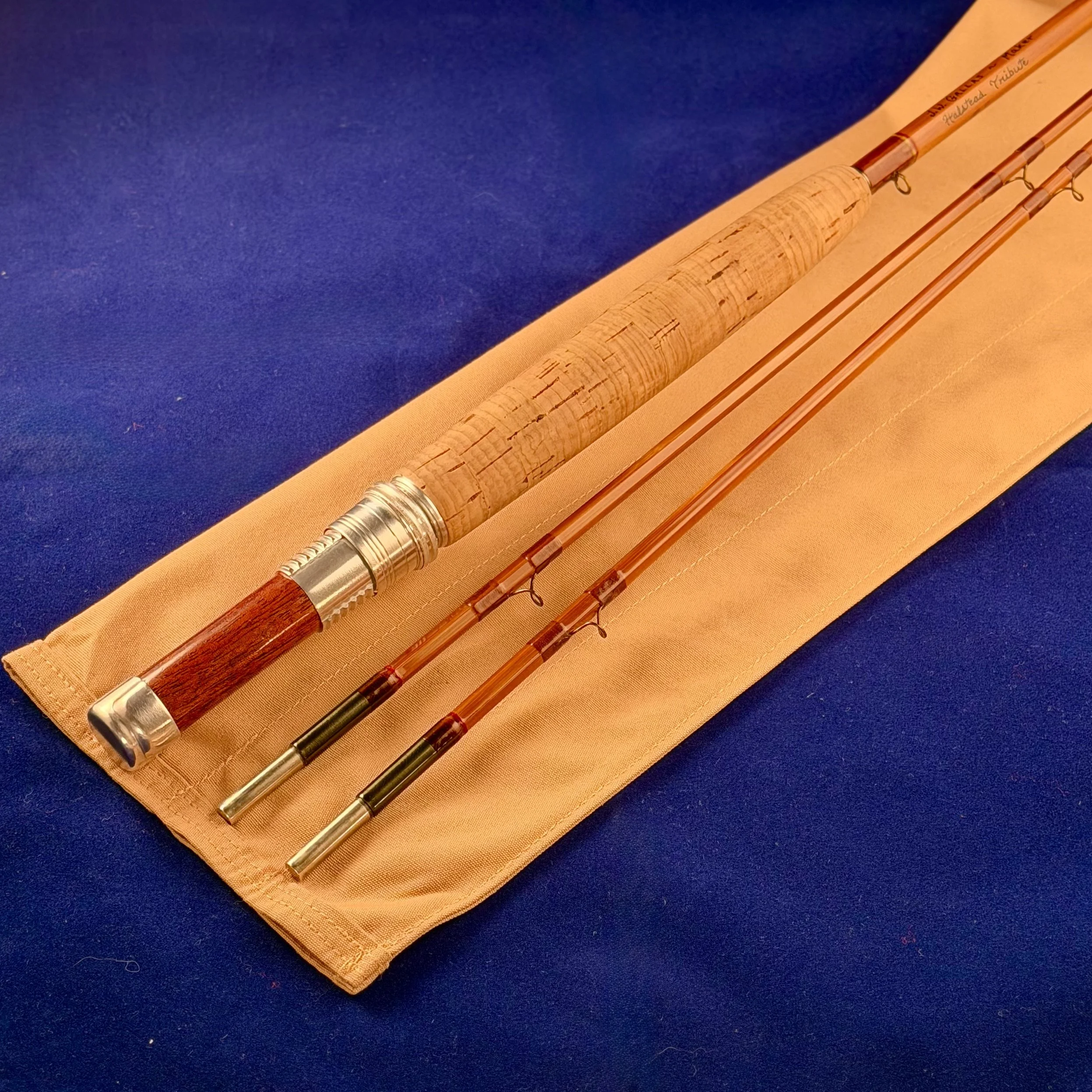
This project represented something more than the completion of unfinished rods. It was an act of preservation, connecting two generations of Danbury craftsmen through a shared respect for the traditions of American bamboo rodmaking. Gallas subsequently developed his own Halstead Tribute Series, one rod we sell here at Alder Creek, drawing upon the distinctive parabolic designs associated with the earlier maker. These rods remain an especially interesting part of his legacy, combining historical inspiration with the skill and judgement of an accomplished modern craftsman.
A Reputation Built Among Anglers
Although Gallas was respected among knowledgeable collectors, his name remained less widely recognised than those of some contemporary American rodmakers. This was partly a reflection of his approach to business. He relied heavily on personal contact and word of mouth rather than extensive advertising. Owners frequently praised not only the workmanship of his rods but also his patience, generosity and willingness to discuss individual casting preferences. His rods found appreciative owners in the United States and abroad, including among European collectors. For Gallas, the ultimate measure of a rod was not its appearance in a catalogue or its reputation among collectors, but the experience it offered on the water.
The Legacy of John W. Gallas
John William Gallas died on November 18, 2023, at the age of 73. His obituary remembered a devoted craftsman, an enthusiastic angler and a man with a deep appreciation of the natural world. He was also a musician, a family man and someone whose warmth and humour were remembered by those who knew him. Among the tributes following his death was one from fellow bamboo rodmaker Walt Carpenter, who recalled their longstanding friendship and mutual respect for the craft.
Gallas left behind a body of work that deserves a lasting place in the history of contemporary American bamboo rodmaking. His rods reflect an uncommon combination of technical understanding, personal craftsmanship and historical awareness. They are also reminders of an era when a rodmaker could spend decades quietly perfecting his work, building a reputation one rod and one angler at a time.
Sources & References
J.W. Gallas Rod Company. Original Catalogue and Rod Specifications. Classic Fly Fisherman.
https://www.classicflyfisherman.com/JOHN_GALLAS.htmThe American Fly Fisher. Volume 34, Number 1, Winter 2008. American Museum of Fly Fishing. Historical account of George H. Halstead and John Gallas's work with surviving Halstead bamboo blanks.
https://www.amff.org/wp-content/uploads/2016/01/2008-Vol34-No1web.pdfThe Classic Fly Rod Forum. John Gallas – Discussion and Owner Experiences.
https://classicflyrodforum.com/forum/viewtopic.php?t=68743The News-Times / Legacy.com. John and Marion Gallas – Obituary. Biographical information and personal tributes.
https://www.legacy.com/us/obituaries/newstimes/name/john-and-marion-gallas-obituary?id=54275111