Hardy of Alnwick
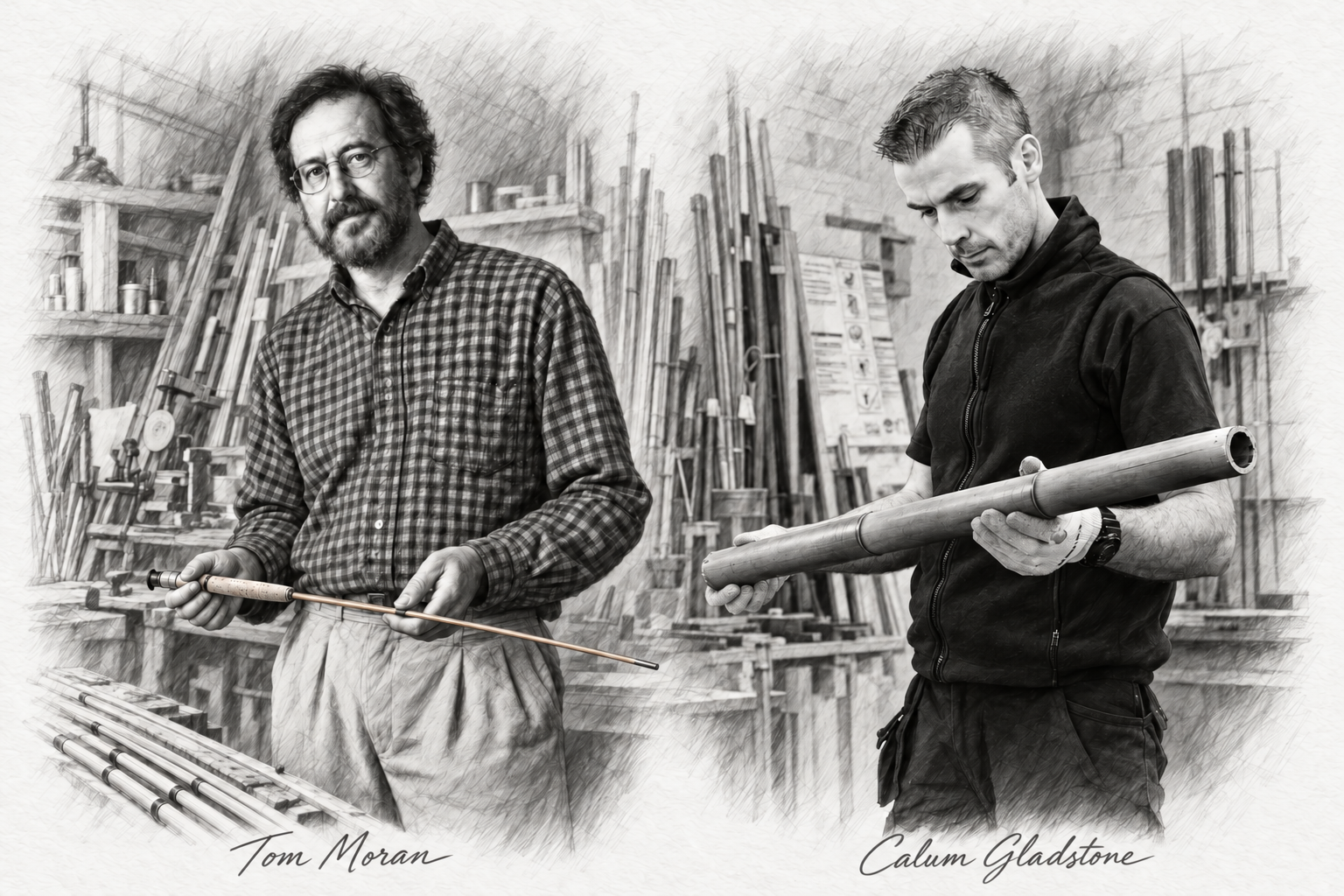
Tom Moran and Calum Gladstone
Alnwick, Northumberland — since 1872
Hardy’s place in fly-fishing history rests as much on its bamboo rods as on its celebrated reels. For generations, the Alnwick workshops produced split-cane rods for an extraordinary range of fishing, from delicate trout fishing on small streams to salmon fishing on the largest rivers.
The company began in 1872, when William Hardy established a gunsmith’s business in Alnwick. Joined by his brother John James, he soon expanded into fishing tackle. William provided the commercial discipline, while John James brought practical angling knowledge, an inventive mind and considerable casting ability. Their partnership laid the foundations of a business whose influence would reach far beyond Northumberland.
Palakona and the Alnwick tradition
By the early 1880s, split bamboo had become an important part of Hardy’s development. The firm’s success at the International Fisheries Exhibition in London in 1883 helped establish its reputation, and the Palakona name became closely associated with its bamboo rods. In its catalogues, Hardy emphasised the selection and seasoning of the raw material, the accurate fitting of the six triangular strips, and the attention given to taper, balance and finishing.
Palakona was principally a registered trade name used across Hardy’s split-bamboo range. A rod bearing the familiar Palakona inscription might therefore be a C.C. de France, a Marvel, a Perfection or one of many other designs. Much later, Hardy also offered a model specifically named the Palakona, adding another chapter to a name already familiar to generations of anglers.
The construction evolved considerably over the decades. Alongside conventional six-strip rods, Hardy offered steel-centred versions, intended to provide additional strength and resilience, and double-built construction for heavier work, with an inner and outer arrangement of bamboo strips. Its interwar catalogues presented these as practical choices for different fishing demands. Natural cane finishes, protective varnish and optional subdued finishes accompanied an extensive selection of fittings and configurations.
Later, hollow construction provided another approach. The Hollolight used hollow-built split bamboo to reduce weight, demonstrating that Hardy continued to develop cane construction as newer rod materials entered the market.
A rod for almost every water
Hardy’s bamboo history encompasses many distinct actions and purposes. Its catalogues offered an unusually broad choice, reflecting the different requirements of river, loch and salmon fishing.
The Perfection was presented as a medium-action rod for general fishing. The Pope provided a more powerful dry-fly design, while the Houghton combined dry-fly capability with usefulness for loch and sea-trout fishing. The L.R.H. Dry Fly, associated with Lawrence Robert Hardy, reflected extensive practical testing and the preference for a firmer dry-fly action. These distinctions mattered: Hardy offered anglers a choice of how a rod should behave, as well as its length and weight.
Among the lighter trout rods, the Marvel and Phantom became enduring names. Hardy promoted the Marvel for delicate, accurate dry-fly work, while the Phantom offered a light, strong design intended for precise casting. The Koh-i-Noor occupied another established place in the range, described in the 1970 catalogue as a medium-action fly rod.
At the other end of the scale stood substantial salmon rods such as the Wye, described by Hardy as an all-round design for general salmon fishing. Together, these models illustrate the breadth of the Alnwick workshops: the same maker supplied both refined trout rods and powerful tackle intended for demanding river work.
The C.C. de France
Few Hardy bamboo rods have a more distinctive history than the C.C. de France. Its name came from the Casting Club de France, where John James Hardy competed in 1910 with a specially built seven-foot rod weighing approximately three ounces.
The accuracy event required casts towards targets beneath overhanging branches. Hardy won his section with a twenty-five-yard cast, demonstrating the capabilities of a short, light rod at a time when much longer trout rods were commonplace. Introduced commercially in 1911, the C.C. de France became one of the company’s best-known bamboo designs.
Its appeal lay in the relationship between its compact dimensions and purposeful action: a rod developed for controlled, accurate delivery. The design enjoyed a long catalogue life and returned in later editions, including the revival undertaken by Tom Moran and Calum Gladstone a century after its introduction.
An international reputation
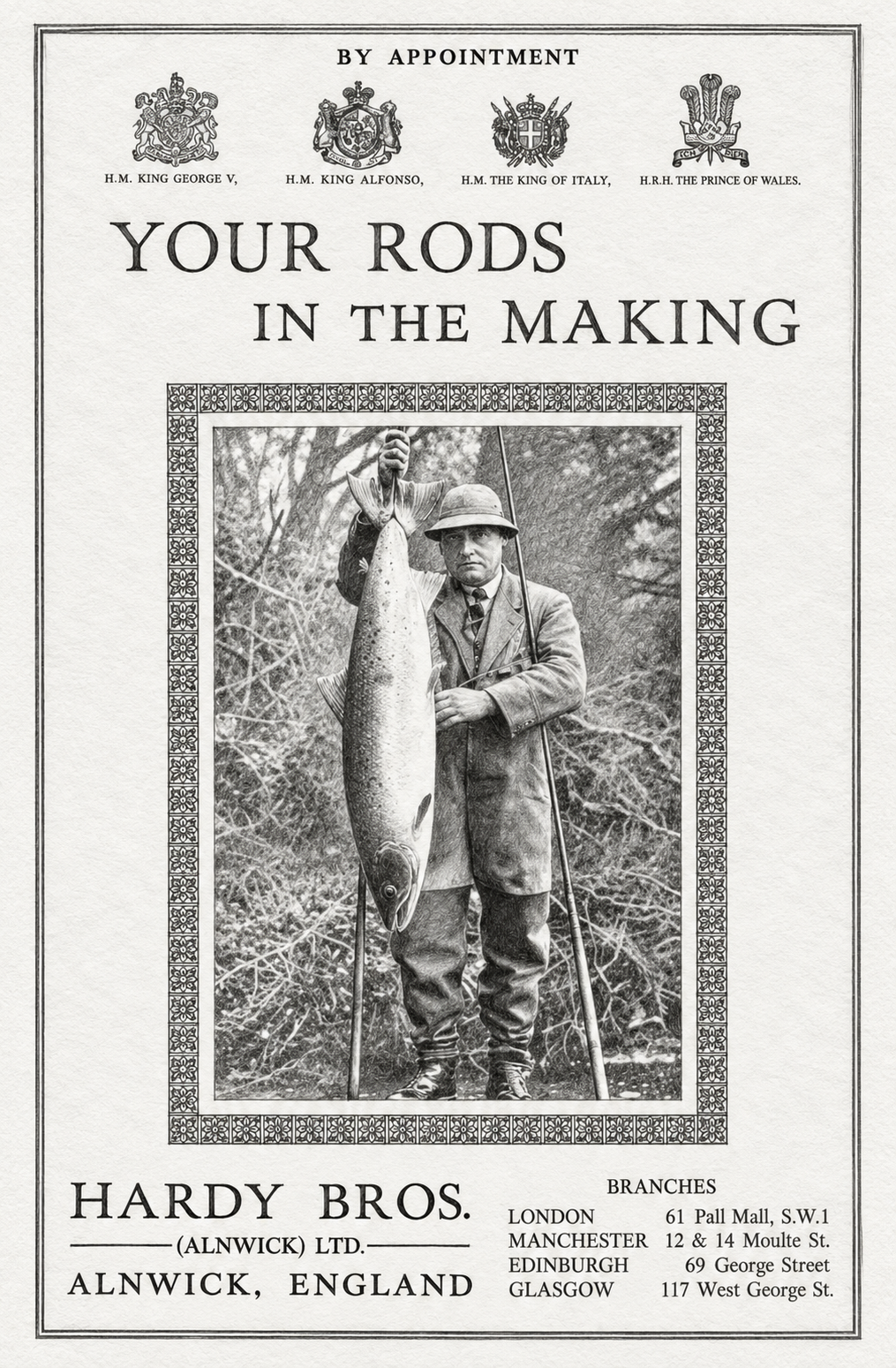
Hardy’s popularity grew through the combination of workmanship, competitive casting success and an extensive commercial network. Its London shop at 61 Pall Mall brought the company closer to an influential clientele, while overseas agents carried its tackle to markets across Europe and much further afield. The Anglers’ Guides presented the range to successive generations, combining detailed product descriptions with the authority of practical fishing experience.
The longevity of designs such as the C.C. de France, and the later reintroduction of models including the Marvel and Phantom, speak to their lasting appeal. As fibreglass and carbon transformed rod production, Hardy’s bamboo designs continued to find an audience and eventually became the subject of renewed specialist craftsmanship.
Tom Moran and Calum Gladstone
A distinguished later chapter began when Tom Moran joined Hardy in 2010. An accomplished independent maker whose experience included work at Thomas & Thomas in America, Moran brought a meticulous approach to bamboo selection, compound tapers and component making. His handmade snake guides were among his characteristic details. He worked at Hardy for four years, until his death in 2014.
Calum Gladstone brought decades of experience within the Alnwick tradition. Beginning with a three-year apprenticeship, he spent some thirty years at Hardy, building rods including the Marvel and C.C. de France. His four years alongside Moran included work on the Hardy Moran and Gladstone series and on Moran’s private commissions. Hand-split bamboo, carefully prepared nodes, fine silk wraps and exacting finishes defined their approach.
Their collaboration connected Hardy’s historic designs with the standards and individual attention of specialist bamboo making. Gladstone subsequently carried their shared techniques into his own work, including the Gladstone Dove, based on the seven-foot C.C. de France. It is a fitting continuation of Hardy’s bamboo story: a design first demonstrated by John James Hardy, preserved and developed through the hands of later craftsmen.
Sources