“The Makers”
Glenn Brackett
There are rodmakers whose names are inseparable from the history of American bamboo, and Glenn Brackett is among them. For decades, his work has represented a quiet commitment to traditional craftsmanship, thoughtful rod design and the belief that a fine fly rod should be judged, above all, by the way it fishes.
Best known for his long association with R.L. Winston and later as a founder of Sweetgrass Rods in Twin Bridges, Montana, Brackett belongs to a generation of craftsmen who carried the traditions of classic American bamboo rodmaking into the modern era.
The Winston Years — Learning and Refining the Craft
Glenn Brackett joined R.L. Winston in 1974, during a period of considerable change for the company. Tom Morgan had acquired Winston the previous year, bringing with him a deep appreciation for the qualities of bamboo and a philosophy of rod design shaped by a lifetime spent on trout streams. At Winston, Brackett developed his skills within a tradition established by Lew Stoner and later refined under Doug Merrick. The company's reputation rested in part on its hollow-built bamboo construction, an approach that combined reduced weight with strength, responsiveness and exceptional casting qualities.
When Winston moved from San Francisco to Twin Bridges, Montana, in 1976, Brackett became an important figure in the continuation of its bamboo rodmaking tradition. Over the following decades, he helped preserve and develop the skills required to produce fine split-cane rods at a time when graphite was becoming the dominant material in modern fly fishing. For Brackett, however, bamboo was never simply a reminder of an earlier age. It remained a material of remarkable character and versatility, capable of producing rods with a delicacy, rhythm and sense of connection that many anglers continue to value.
The Boo Boys’ — A Brotherhood of Bamboo
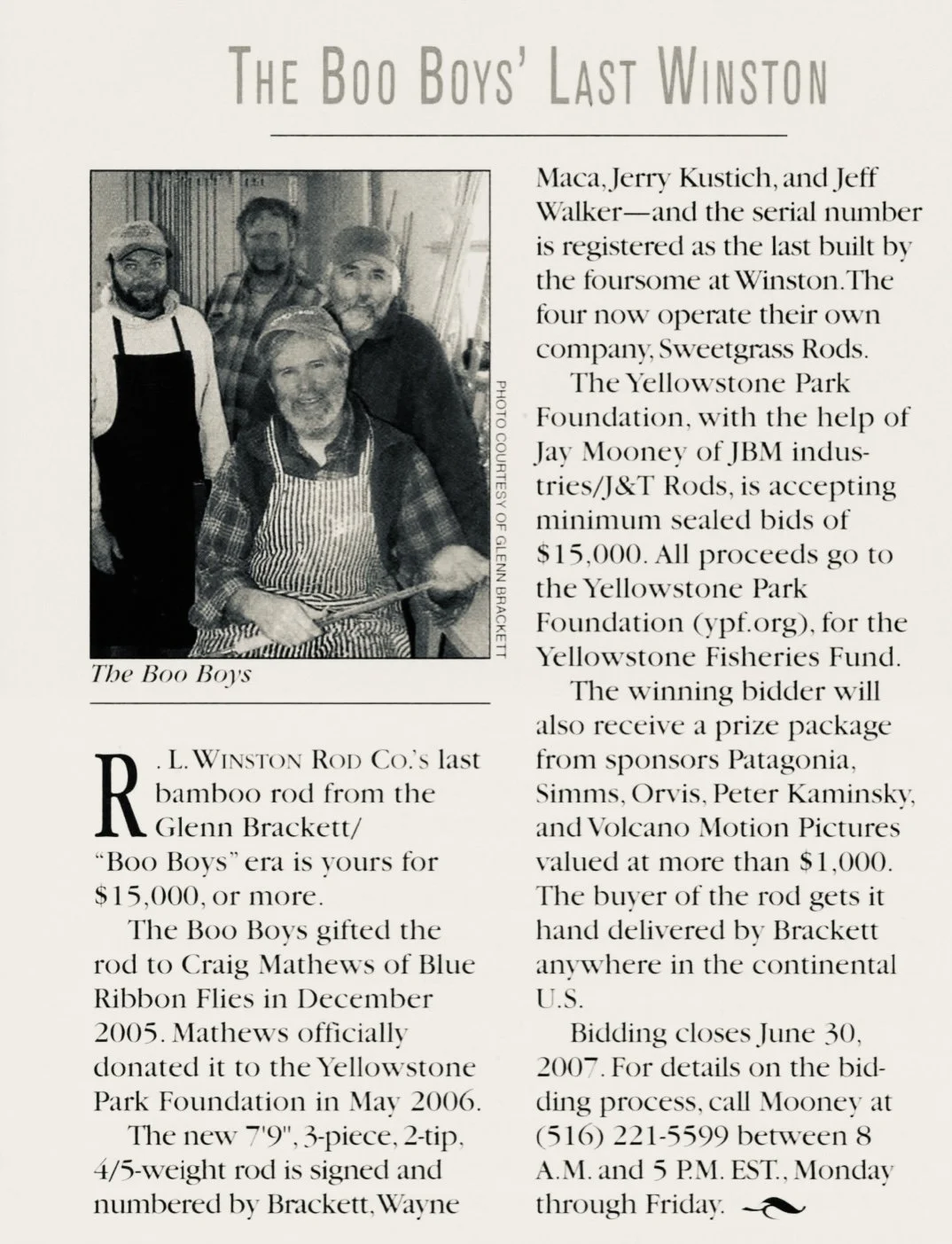
During his years at R.L. Winston, Glenn Brackett became closely associated with a small group of dedicated bamboo rodmakers affectionately known as The Boo Boys’ — a name derived from their shared passion for bamboo.
Alongside Jerry Kustich, Jeff Walker and Wayne Maca, Brackett belonged to a remarkable circle of craftsmen united by their devotion to traditional split-cane rodmaking. More than simply colleagues at the rod bench, they shared a philosophy rooted in patience, precision and an intimate understanding of bamboo. Their craftsmanship was built upon decades of accumulated knowledge, with techniques and traditions passed from one rodmaker to another through years of working together. Each brought his own experience and individual skills, contributing to a shared understanding of what makes a truly fine bamboo fly rod.
In 2006, Brackett and his fellow craftsmen left Winston to establish Sweetgrass Rods in Twin Bridges, Montana. Their departure marked the beginning of a new chapter in American bamboo rodmaking, but also the continuation of a tradition they had spent much of their working lives preserving. In many ways, Sweetgrass embodied the spirit of the Boo Boys’ — a workshop founded upon craftsmanship, friendship and the conviction that fine bamboo rods should continue to be made by hand, one at a time.
Their legacy is not simply the rods they produced, but the knowledge, dedication and shared sense of purpose that continue to define the finest traditions of American bamboo rodmaking.
Sweetgrass Rods — A New Chapter in Montana
Sweetgrass was founded upon a straightforward philosophy: to continue making fine bamboo fly rods using traditional methods, while allowing the experience and individual judgement of the rodmaker to guide every stage of construction.
The name itself evokes the landscape of the American West, and the rods reflect the fishing traditions of Montana's celebrated trout rivers. At Sweetgrass, the emphasis has remained on carefully selected cane, precisely executed tapers and the many small details that distinguish a handcrafted rod from a mass-produced instrument.
Brackett's work carries forward the Winston tradition while possessing an identity of its own. Sweetgrass rods are appreciated for their elegant appearance, thoughtful design and, most importantly, their qualities on the water.
The Sweetgrass Rod — Character and Craftsmanship
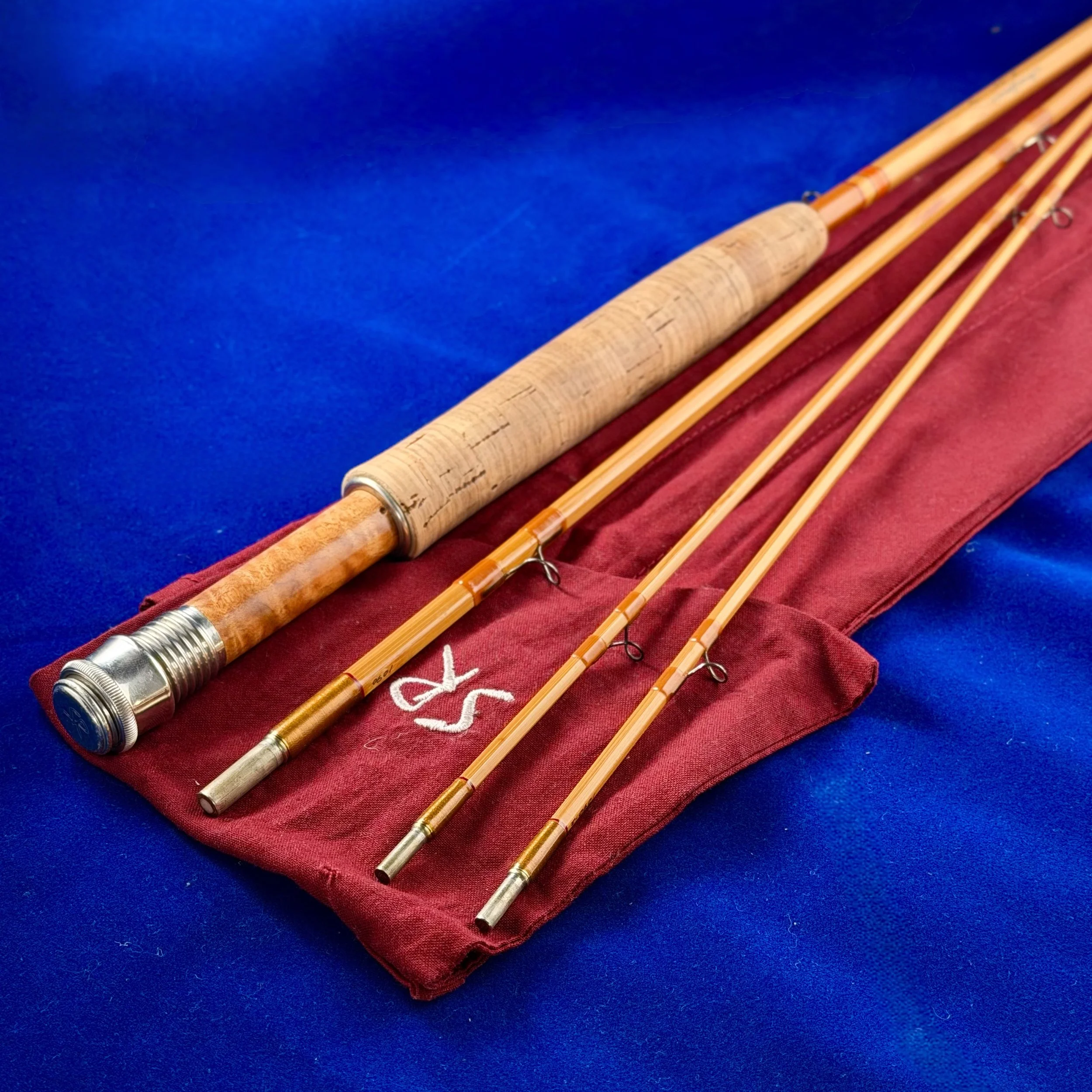
A Sweetgrass bamboo rod is immediately recognisable for its restrained elegance. The warm tones of the cane, carefully executed silk wraps and traditional fittings reflect a philosophy in which every component serves the finished rod. Yet the real distinction lies beneath the surface. The preparation of the bamboo, the accuracy of the taper and the relationship between the individual sections determine how the rod behaves in the hand. These are qualities that require both technical knowledge and the experience acquired through decades at the rod bench.
Sweetgrass has also explored bamboo construction beyond the conventional six-sided rod, producing designs with different cross-sectional geometries and a wide range of fishing applications. This willingness to experiment, while remaining faithful to traditional materials, reflects Brackett's belief that bamboo rodmaking is a living craft rather than a fixed historical practice.
From Twin Bridges to Butte — The Tradition Continues
In 2017, Sweetgrass Rods entered another chapter in its history when Glenn Brackett moved the workshop from Twin Bridges to Butte, Montana. After more than four decades closely associated with the bamboo rodmaking tradition of Twin Bridges, Brackett chose to continue his work in a smaller, more personal setting. The move marked a change in location and organisation, but not in the philosophy that had guided his career.
In Butte, Brackett continues to devote himself to the craft he had spent a lifetime refining. The emphasis remain on carefully selected bamboo, thoughtful tapers and the individual attention that distinguishes a handcrafted rod. The relocation also reflected the evolving nature of Sweetgrass itself. What had begun as a collective endeavour among the Boo Boys’ increasingly centred on Brackett's personal craftsmanship and his commitment to passing on the knowledge of traditional bamboo rodmaking.
Today, Sweetgrass Rods continues its work in Butte, carrying forward a tradition that stretches from the early Winston workshop in San Francisco, through the celebrated years in Twin Bridges, to Brackett's own bench in Montana. For collectors and anglers, this continuity is part of the appeal of a Sweetgrass rod. Each represents not only the work of an individual craftsman, but a living connection to nearly a century of American bamboo rodmaking.