“The Makers”
H.L. Leonard
H.L. LEONARD
The House That Leonard Built
Few names are as closely associated with the American bamboo fly rod as H.L. Leonard.
Founded by Hiram Lewis Leonard in the nineteenth century, the Leonard Rod Company helped establish many of the methods, proportions and standards that came to define the American split-bamboo fly rod. From the early days in Maine to the celebrated Central Valley years, Leonard rods were made for generations of anglers who valued lightness, refinement and an unmistakably delicate feel in the hand.
More than a century later, the finest Leonard rods remain among the most recognisable and sought-after examples of American rodmaking.
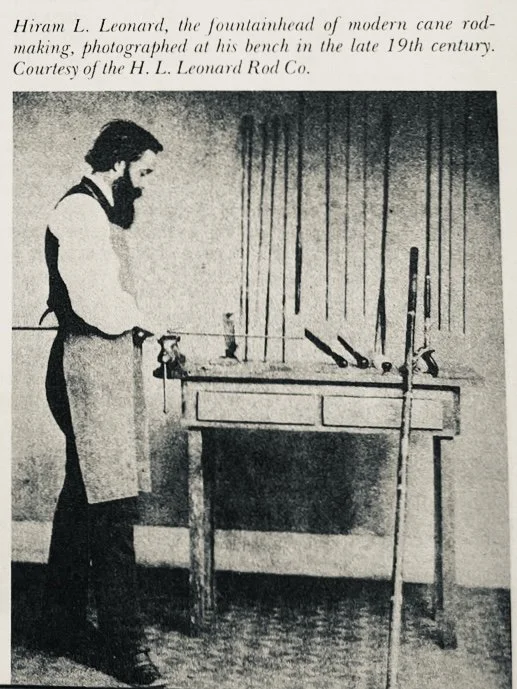
HIRAM LEWIS LEONARD
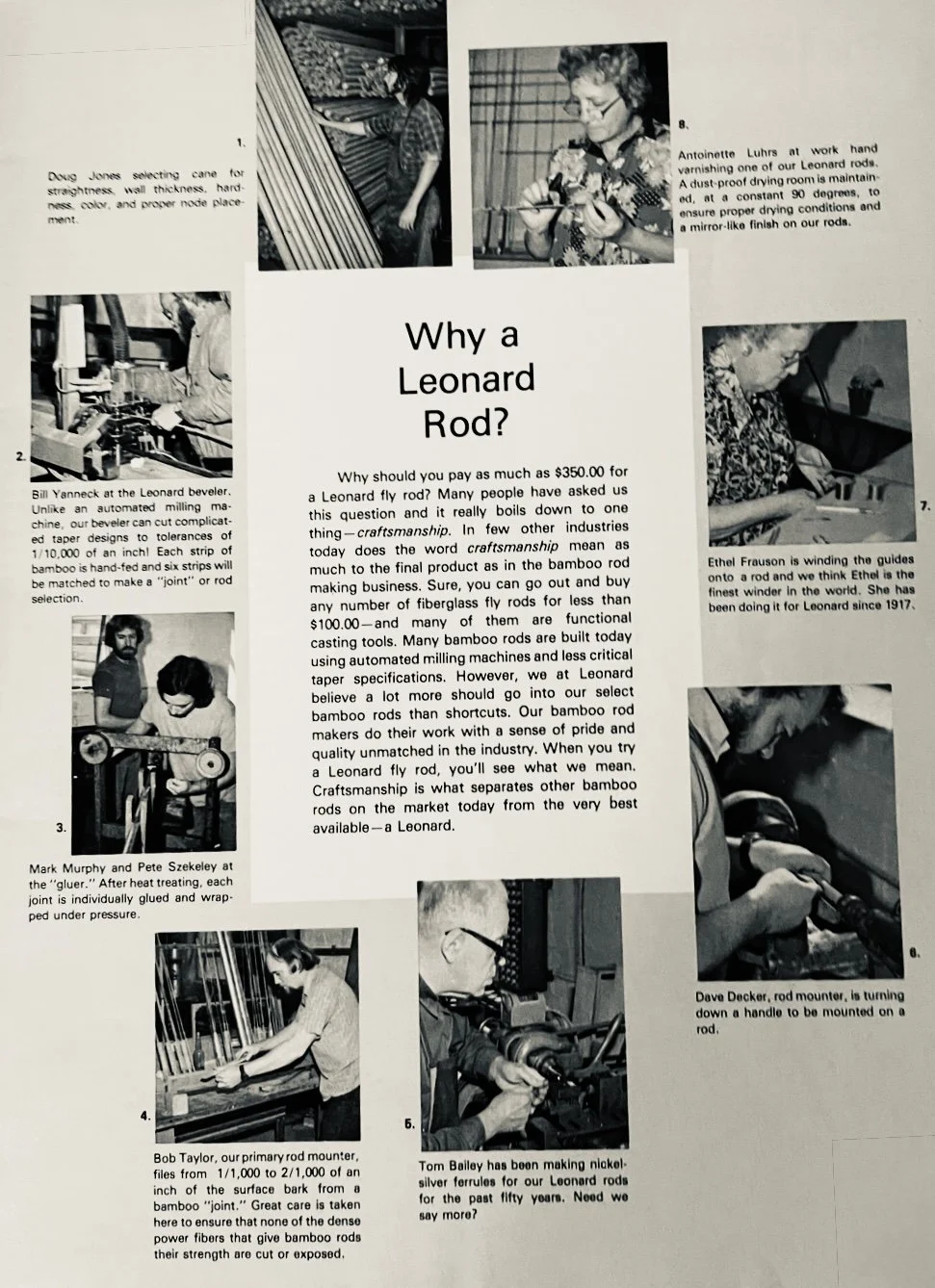
Hiram Lewis Leonard began making fishing rods in Maine in the 1860s. A gunsmith and machinist by background, Leonard brought unusual mechanical precision to a craft that was still developing.
His importance extends far beyond the rods bearing his name. The Leonard shop became one of the great schools of American rodmaking. Craftsmen associated with Leonard would go on to influence or establish other important names in the history of the bamboo rod, spreading Leonard methods and ideas throughout the American trade.
The company eventually established itself at Central Valley, New York, where Leonard rods would be produced for much of the twentieth century.
THE LEONARD TRADITION
Leonard became particularly associated with rods of remarkable delicacy.
The classic Leonard action is difficult to reduce to a single description. Models and periods vary considerably, but the best examples often combine a relatively light feel in the hand with progressive flex and considerable sensitivity. Rather than relying simply upon power, many Leonard tapers allow the entire rod to participate in the cast.
This character is particularly apparent in the lighter trout rods for which Leonard became famous. Models such as the 50Df, Catskill, and later Hunt rods have become landmarks of American bamboo rodmaking.
THE CATSKILL RODS
Among the most celebrated Leonard rods are those carrying the Catskill designation. Built as exceptionally light trout rods, the Catskill series represents perhaps the purest expression of Leonard's pursuit of delicacy. Fine tips, carefully proportioned tapers and minimal unnecessary weight produced rods that could present a dry fly with remarkable precision. Original examples in desirable lengths and line weights are consequently among the Leonard rods most closely followed by collectors today.
The Catskill name would continue through different periods of Leonard production, including later interpretations of these famous tapers.
THE 50DF AND TOURNAMENT RODS
The Model 50 family occupies another important place in Leonard history.
The 8-foot 50DF, particularly in its three-piece configuration, became one of the archetypal Leonard trout rods. The designation is generally associated with a dry-fly-oriented action, combining the delicacy expected of a Leonard with sufficient authority for broader fishing situations. Fine pre-fire examples of the 50DF remain particularly desirable.
FIRE AND THE END OF AN ERA
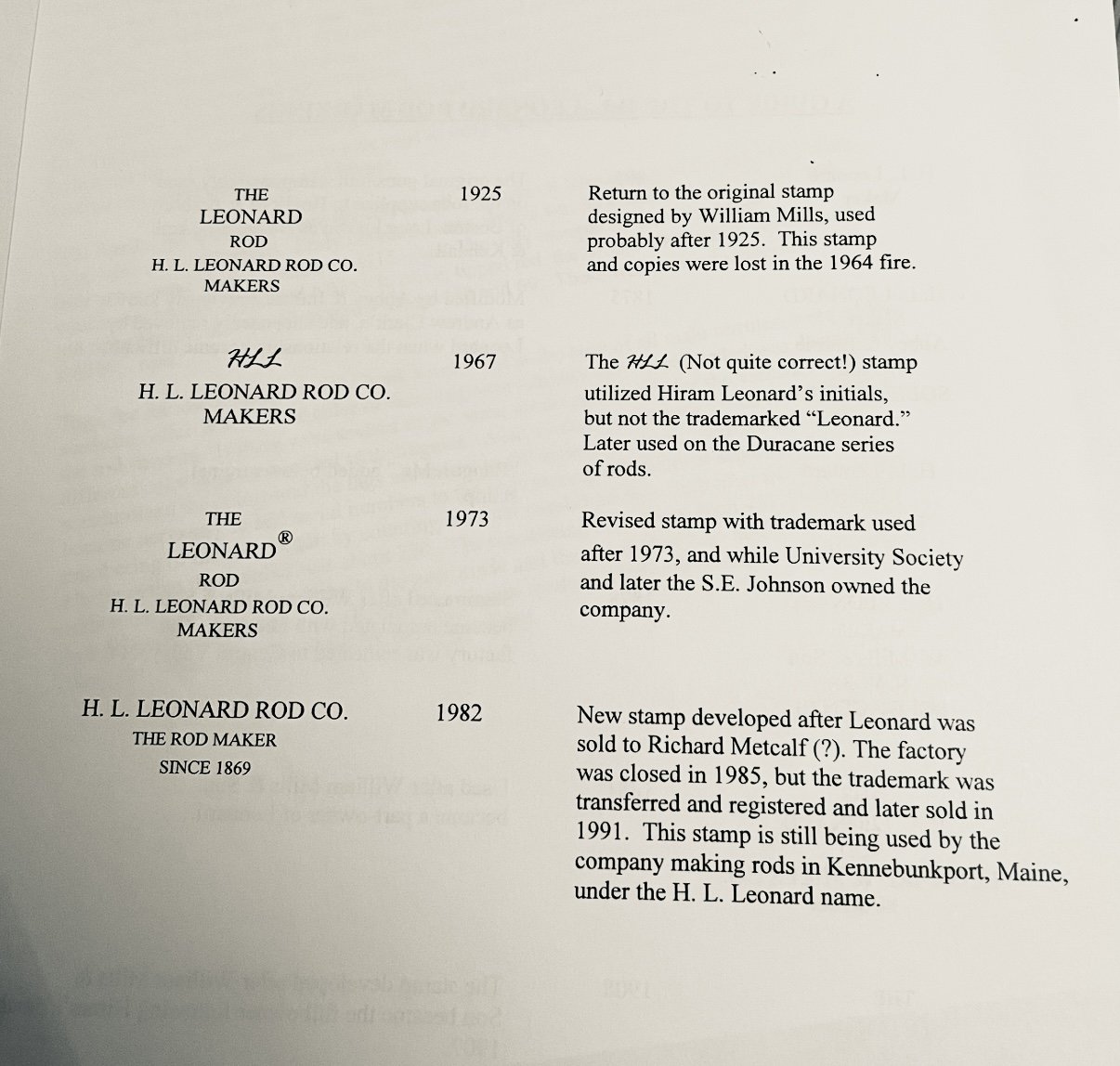
In 1964, fire struck the Leonard shop at Central Valley.
The event created one of the most useful dividing lines for collectors: pre-fire and post-fire Leonard. Much of the company's equipment, materials and records were affected, and rods produced before the fire consequently belong to a distinct chapter in Leonard history. “Pre-fire” does not automatically mean that one rod is superior to another, but for collectors it can be an important element of identification, provenance and value.
Leonard continued after the fire, eventually entering another particularly interesting period under the influence of Tom Maxwell.
THE TOM MAXWELL YEARS
Before joining Leonard, Maxwell had co-founded Thomas & Thomas with Tom Dorsey in 1969, helping to establish the company during the renaissance of American bamboo rodmaking.
In the late 1970s, Maxwell moved to Leonard to head its rodmaking operation. His relatively brief tenure is now regarded by collectors as an important period in the company's later history. Maxwell brought considerable technical knowledge, a strong appreciation for traditional rodmaking and an insistence upon careful workmanship. Under his direction, Leonard continued producing classic models while also developing rods that reflected the changing demands of contemporary anglers.
Among the notable rods associated with this period are the Hunt series and Leonard's impregnated bamboo rods. Specialist collectors commonly distinguish rods from this period as "“Maxwell Leonards” or “Maxwell-era”, although the designation refers to the period and Maxwell's direction of the workshop rather than necessarily indicating that Maxwell personally built every individual rod.
Today, these rods are appreciated both as highly capable fishing instruments and as representatives of an important chapter in the history of American bamboo rodmaking. Read more about Tom Maxwell in our separate profile.
THE DURACANE
One of the more interesting developments of the later Leonard period was the company's impregnated bamboo rod.
Originally associated with the name Duracane, and subsequently marked The Duracane, these rods represented a distinctly practical interpretation of the Leonard tradition. Impregnation reduced the bamboo's dependence upon a conventional varnish finish and produced a rod particularly resistant to moisture and hard use. Despite their practical construction, the best examples remain unmistakably Leonard in character.
Today, Maxwell-era Duracane rods (marked “The Duracane”9 occupy an interesting position for collectors: comparatively modern and highly fishable, yet firmly connected to one of the oldest names in American bamboo rodmaking.
IDENTIFYING A LEONARD
Dating a Leonard rod can require consideration of several characteristics rather than relying upon one feature alone.
Useful details include:
Model designation
Serial number
Writing style and inscriptions
Ferrule design
Reel-seat hardware
Grip configuration
Wrap colours
Rod bag and tube
Labels and decals
Construction details
Provenance
The 1964 fire and subsequent changes in ownership and production make the history particularly interesting, but they can also make precise dating difficult. For important rods, the entire object should therefore be considered rather than relying solely upon a serial number. An important reference in identifying and dating a leonard rod is the Leonard Database.
COLLECTING H.L. LEONARD RODS
Condition, originality and configuration have a substantial influence on the desirability of a Leonard rod. For collectors, particular attention should be paid to whether a rod retains its original length, ferrules, guides, wraps, grip, reel seat, bag and tube. Two full-length original tips are generally preferred where the rod was originally supplied in that configuration.
A professionally restored Leonard can nevertheless remain an excellent and historically important fishing rod. Restoration should therefore be clearly described rather than regarded simply as a defect. Beyond condition, certain combinations of model, length, line weight and period are considerably scarcer than others. Ultimately, however, Leonard rods were made to be fished.
The finest examples remain compelling not merely because of their history, but because the qualities that established Leonard's reputation can still be experienced on the water.
H.L. LEONARD AT ALDER CREEK
Alder Creek regularly handles Leonard rods from different periods of the company's history. The collection has included examples from the classic pre-fire era as well as rods associated with Tom Maxwell and the later Leonard shop.
LOOKING FOR A PARTICULAR LEONARD?
If you are searching for a particular H.L. Leonard model, length or line weight, please contact Alder Creek. Not every rod available to us necessarily appears on the website, and we are always happy to discuss particular Leonard rods with collectors and anglers.